For decades, he taught in a single room at the Neighborhood Playhouse in New York. What came out of that room changed American acting.
“If you ever meet someone who calls themselves a Master Teacher run from this teacher! What arrogance and ego. I am not a Master Teacher. Even after a half century of teaching I’ve mastered nothing. I’m simply a teacher dedicated to teaching truthful acting and I will never master that.”
Sanford Meisner
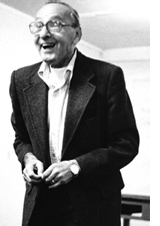
Sanford Meisner is a quiet force behind the modern history of American acting. He is an open secret, known to generations of the most successful and admired actors, writers, and directors, many of who were his devoted students. However, most outside this group have never heard of the master teacher. who influenced more careers than all of the top acting teachings in America combined.
Born August 31, 1905 and raised in Brooklyn, New York, Sanford Meisner graduated from Erasmus Hall in 1923. He went on to attend The Damrash Institute of Music (now Juilliard). While there, he studied to become a concert pianist. His plans changed when he talked his way into a job in Sidney Howard’s They Knew What They Wanted. He realized then that acting really “dug at him.”
In 1931, a fervent group of actors, including Sandy, Stella Adler, Lee Strasberg, and Harold Clurman established the Group Theatre. It was the first permanent theatre company that brought “Method” acting, rooted in Konstantin Stanislavsky’s methods, to prominence in America. Sandy appeared in twelve Group productions, including the first, The House of Connelly, and all of Clifford Odets’s plays. Notably including Waiting for Lefty, which Sandy co-directed with Odets in 1935.
In 1933, Sandy became disenchanted with pure “Method” acting. He wrote,
“Actors are not guinea pigs to be manipulated, dissected, let alone in a purely negative way. Our approach was not organic, that is to say not healthy.”
He had ongoing discussions about technique with Adler, who worked with Stanislavsky in Paris, and Clurman, who took a deep interest in the American character. Eventually Sandy realized that, if American actors were ever going to achieve the goal of “living truthfully under imaginary circumstances,” they needed an American approach. The Neighborhood Playhouse provided him with a venue to develop that approach on his own.
In 1935 he headed the Drama Department at The Playhouse. While there, he still acted and directed plays produced by The Group Theatre. This continued until the Group’s demise in 1940. He also appeared on Broadway between 1944 and 1958.
Sandy left The Playhouse in 1958 to become the director of the New Talent Division of Twentieth Century Fox. He moved to Los Angeles, where he was also able to cultivate his career as a film actor. He starred in Odets’s The Story on Page One (1959), Tender Is the Night (1962), and later Mikey and Nicky (1976).
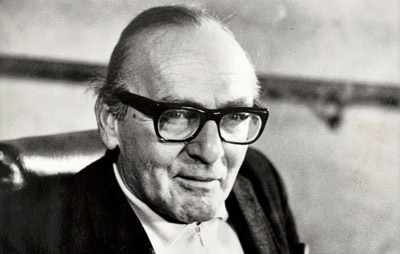
Sandy received commendations from Presidents Clinton, Bush, and Reagan. He received honors from California Governor Pete Wilson and the “Humanitarian of the Year” commendation in 1990 at The Washington Charity Awards. His final appearance as an actor was in a guest-starring role on a special episode of “ER” that aired in February of 1995. After his death on February 2, 1997, Backstage West dedicated an issue to Sandy and his world-renowned “Meisner Technique.”
Arthur Miller once said of Sandy, “He has been the most principled teacher of acting in this country for decades now, and every time I am auditioning actors I can pretty well tell which ones have studied with Meisner. It is because they are the most honest and simple and don’t lay on complications that aren’t necessary.”
Until his death on February 2, 1997 at the age of ninety-one, Sanford Meisner was one of the world’s most influential and respected teachers of acting. In fact, no teacher of acting in the history of theatre and film has produced a more extensive and prodigious “who’s who” of actors than Sanford Meisner, yet most people outside the professional world of theatre have never even heard of him.